


The UNESCO Chair on Sustainability brings responsible participatory AI for the WEFE Nexus to the UNESCO–UN-Water capacity development session at the Euro-Mediterranean Water Forum 2026

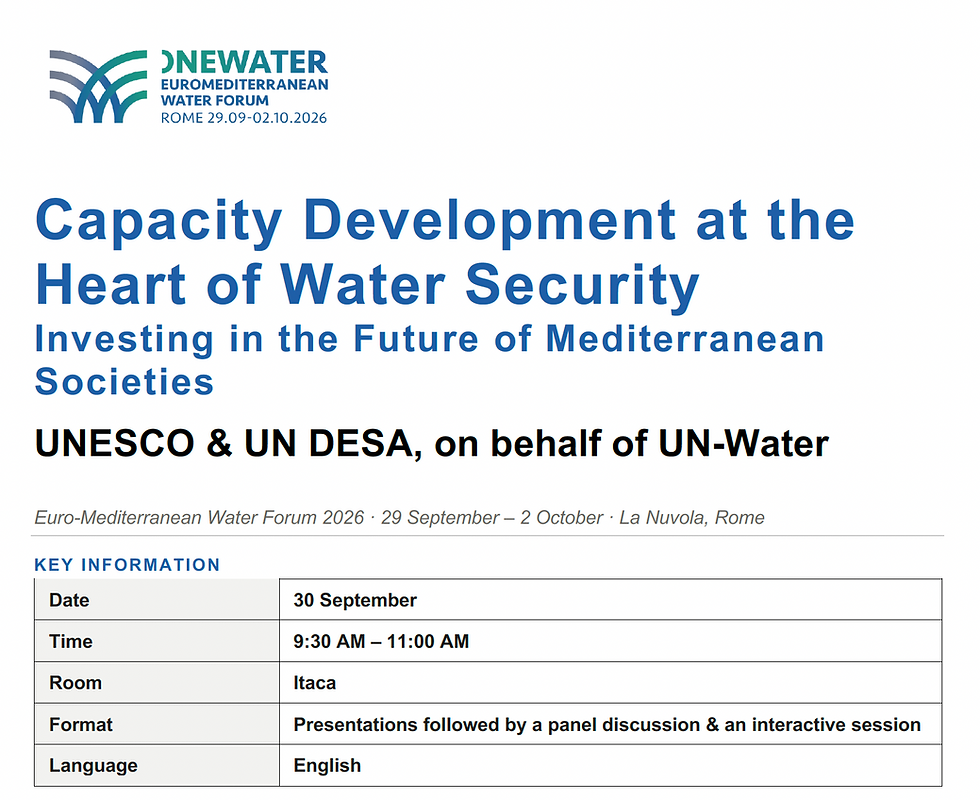
Jordi Morató and Olga Lucía Sánchez Santander represented the Chair in Rome at the session "Capacity Development at the Heart of Water Security: Investing in the Future of Mediterranean Societies," organized by UNESCO and UN DESA on behalf of UN-Water.
Rome, 30 September 2026

The UNESCO Chair on Sustainability of the Universitat Politècnica de Catalunya (UPC) took part in the Euro-Mediterranean Water Forum 2026, held at La Nuvola in Rome from 29 September to 2 October, as an invited contributor to the session "Capacity Development at the Heart of Water Security: Investing in the Future of Mediterranean Societies." The session was organized by UNESCO and the United Nations Department of Economic and Social Affairs (UN DESA) on behalf of UN-Water, and was led by Dr. Sarantuyaa Zandaryaa, Programme Specialist and Lead of the IHP theme "Water for Human Settlements" at UNESCO's Division of Water Sciences – IHP Secretariat.

The Chair was represented by its Director, Prof. Jordi Morató, and by researcher Olga Lucía Sánchez Santander. Their contribution, prepared together with Prof. Pau Fonseca i Casas of INLAB (UPC), was titled "Building Capacity for Water Resilience: Responsible Participatory AI for WEFE Nexus Decision-Making."
The session was framed around the UN-Water SDG 6 Capacity Development Initiative (CDI), the inter-agency platform co-coordinated by UNESCO and UN DESA that supports countries in moving from one-off training toward nationally led, systemic capacity development for water and sanitation. Now deployed in nine pilot countries, including Jordan in the Mediterranean, the CDI follows a step-by-step methodology that runs from inter-ministerial engagement and capacity gaps assessment to the design of National Capacity Development Plans. The Rome session brought a Euro-Mediterranean perspective to that experience, opening a dialogue between the CDI and the dense ecosystem of universities, UNESCO Chairs, water education institutes and training providers active across the region, and positioning capacity development as a long-term investment in water security on the road to the UN 2026 Water Conference in Abu Dhabi and the 11th World Water Forum in Riyadh in 2027.
Understanding complexity before building capacity
The Chair's presentation started from a simple premise: before capacity can be developed, the complexity of the systems in which people make decisions has to be made understandable. Water, energy, food and ecosystems cannot be understood in isolation; their interactions cut across sectors, scales, actors and competing objectives. The challenge, Morató argued, is not to simplify that complexity away but to make it legible to the institutions and communities that must act on it. Against the backdrop of the Mediterranean climatic reality, where water demand is rising as supply declines and more than 180 million people already face water scarcity, the presentation made the case for moving from single technologies to integrated socio-ecological and technical systems (SETs). AI-driven analysis across the Euro-Mediterranean region shows that isolated measures, such as desalination without renewables or irrigation efficiency without soil conservation, rarely deliver optimal WEFE Nexus outcomes; system bundles do.
A central message concerned the kind of AI that is fit for this purpose. Black-box models, whose internal logic is not visible, leave stakeholders unable to understand, trust or replicate their recommendations. The Chair instead advocates participatory and explainable AI, in which decisions are made by a human-supervised system with operator approval, and in which the model itself is co-designed with stakeholders. AI, as the presentation put it, is not a substitute for governance: it becomes valuable only when institutions and stakeholders have the capacity to understand, use and govern it.
The SURENEXUS participatory AI framework
The approach was illustrated through the SURENEXUS project (PRIMA, co-funded by the European Union), which brings together 15 institutions from seven countries to deploy small-scale demonstrators of bioeconomy and nature-based solutions for the WEFE Nexus in Spain, Greece, Morocco and Tunisia. Its participatory AI framework moves through four stages: participatory pre-selection of candidate solutions using multi-criteria analysis with locally defined weights; conceptual co-design of a shared Assumptions Document (ADoc) and an SDL-based conceptual model; an executable simulation model in SDLPS, calibrated and validated with site and sensor data; and the NECADA digital twin, with a Compensation Block and a downstream multi-criteria post-process that makes trade-offs explicit and keeps a traceability ledger from assumptions to decision.
Between 2023 and 2025, this process has engaged 934 participants in 22 participatory workshops across seven countries, combining training on WEFE Nexus modeling and AI, on-the-ground action at the demonstration sites, and policy dialogue. Results presented in Rome included solar-powered subsurface irrigation of olive orchards in Tunisia, which used around 84% less water than conventional drip irrigation while raising water productivity 5.7-fold and improving oil quality and soil indicators; AI-supported modeling of mulching and variety options for precision citrus farming in Kenitra, Morocco, with water savings of up to 43% relative to bare soil; and cork-based treatment wetlands for nitrate-polluted winery water in Catalonia, where multi-criteria trade-off analysis compared aerated and non-aerated, solar- and grid-powered configurations.
From the Forum to the CDI: the AIWARE pilot
The presentation closed by connecting this experience to the capacity development agenda of the session. Two future initiatives were highlighted. The first is the IWRA online master class "Responsible AI for Water Resilience and WEFE Nexus Capacity Development," a practice-oriented program of 14 contact hours over eight live sessions that takes participants from WEFE framing and AI-supported scenarios to decision support and policy action, using SURENEXUS cases and tools.
The second is AIWARE, a pilot under the UN-Water SDG 6 Capacity Development Initiative in which the UNESCO Chair on Sustainability acts as technical implementing partner. Over 18 months (September 2026 – February 2028), AIWARE will train between 90 and 120 professionals through online and in-country activities in three Mediterranean pilot basins: the Júcar River Basin in Spain, focused on irrigation modernization, reuse and drought resilience; the Oued Souhil and Nabeul-Hammamet area in Tunisia, focused on wastewater reuse and managed aquifer recharge; and the Drin, Vjosa and Lake Ohrid systems in Albania, focused on transboundary cooperation and hydropower–irrigation–environment trade-offs. Each basin will follow the CDI workflow, from capacity-needs diagnostic and data governance through scenario co-design and an in-country NECADA clinic to institutionalization and policy uptake, delivering scenarios and institutionalization notes at the ministerial and basin-authority level.
The Chair's participation in Rome reflects its sustained commitment to linking research on the Water–Energy–Food–Ecosystems Nexus with the capacity development efforts of the United Nations system in the Mediterranean, and to ensuring that the uptake of artificial intelligence in water governance remains transparent, participatory and accountable.
More information: https://necada.com · https://sdlps.com · Contact: jordi.morato@upc.edu


Comments